
Every year I start my retrospective by complaining about how long it took me to finally sit down and write it. This year, I broke all records. It’s almost June September February on the next year, and here I am, starting to write a review of (last) last year. A little more and this post would have turned into a double review—2024 and 2025 at the same time. (And look at that: I procrastinated for so long that the post actually did become a double one…)
A good part of that time was spent thinking about why I procrastinate this post so much. More than that, I also kept thinking about what the point of having a blog even is if I barely write in it—at least part of me already knows that I keep this around mostly for historical reasons. For me, it’s very hard to simply let things go, and the longer they last, the harder that becomes. This blog has existed—in one form or another—since at least 2002. So you can imagine how difficult it would be for me to simply let it die. In other words, it’s just not going to happen.
And it’s not for lack of topics—there’s a lot that goes through my head that I’d love to put down here. Not only because I think these things are relevant, but also because I’d like this blog to be a record of what I think and feel over the years. And in fact, every now and then I come back here and reread older posts, reliving everything I was going through at the time I wrote them. It’s almost a tool for mental sanity, because for me the past is baggage I carry around all the time. This exercise of revisiting certain moments through photographs, blog posts, and things like that is almost therapeutic, because it feeds this constant need I have to relive meaningful moments in my life.
But back to the point: 2024 (and now 2025 as well).
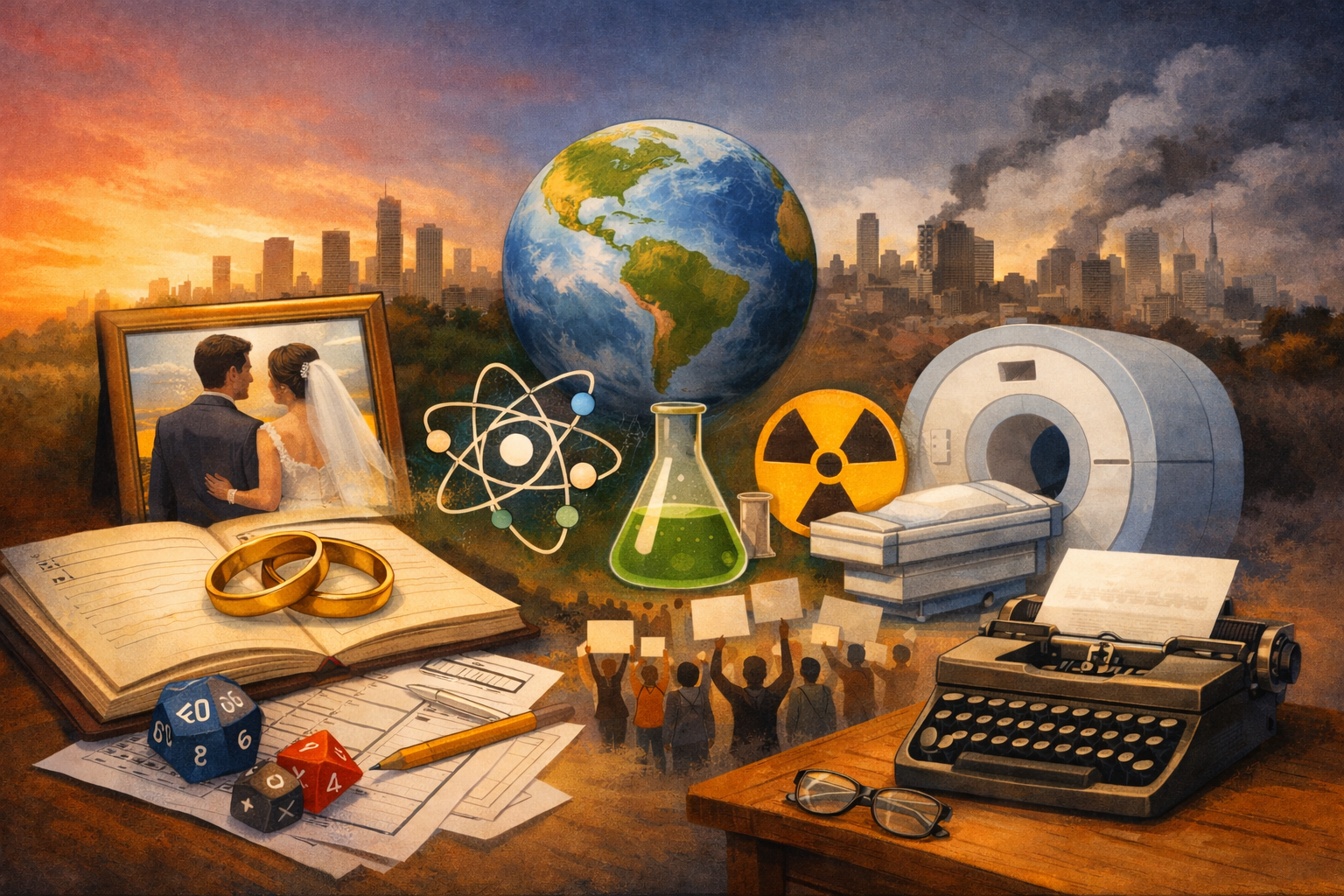
Marriage
I don’t intend to get into a philosophical discussion here about the merits (or lack thereof) of marriage. Nor about how one can know whether it’s worth getting married or not. Suffice it to say that this decision is deeply personal, and the reasons that led me to it are mine alone. But over the years, I’ve become increasingly convinced that “soulmates” don’t exist—we build our own relationships. It’s not something supernatural imposed on us by the Universe. A relationship is constructed; it requires effort and commitment. It’s a strictly human construct, since—in a way—it runs counter to natural instinct.
For me, it’s something comfortable, and when I found a partner who was my equal, I proposed in 2019. She said yes—and then the pandemic happened.
After all that mess had passed—along with other messes that aren’t relevant here—we finally had a confirmed date, through an arrangement that didn’t arise exclusively from our own will, but also from the circumstances surrounding us.
Planning was quick and slightly maddening. We couldn’t spend much, and because of that we ended up accepting commitments that—frankly—we probably shouldn’t have. But we wanted to have that opportunity. We made the most of it, kept the guest list very small, and had a celebration. There may have been problems, but I choose to keep the good memories. We still need to get the recordings and organize the photos—this is what happens when two people with ADHD get married—but it was a very good day. I’m now a married man, with everything that entails.
Naturally, it was more of a formalization—married life hasn’t been very different from life “living together”—but it’s still worth celebrating these things. After all, it’s almost fifteen years together.
That’s not to say there are no challenges—and now solutions tend to be different because there’s bureaucracy involved. But the truth is that, in “real life,” none of what we learn from TV shows and movies truly applies to relationships. Series, films, and other media present idealized situations, where everything is controlled and (to some extent) manipulated so that things happen the way the author(s) want them to. Reality doesn’t work like that, and the outcomes of our actions are—for all practical purposes—unpredictable.
So there’s no point in lecturing about what a marriage is or should be. No one can say that from the outside. Not even other couples—the experience is extremely intimate and personal. It’s no coincidence that it deeply annoys me when someone tries to tell me how my marriage should be or how I should deal with it. Leave me alone; let me handle it my way, because only the two people involved can really understand what’s going on, and even then each perspective is limited, since we only ever see half of the whole.
But I can say this: marriage takes work. And I’m not talking about the party or the celebration. I’m talking about the marriage itself. Things don’t just happen automatically; they require conversation, support, and above all, understanding. Even when married, the two people involved are still different individuals, each with their own thoughts, emotions, goals, and expectations. You have to reach a point of mutual understanding if you want things to move forward.
Another important point is being sure about the reasons why you’re doing this in the first place. Each individual has their own goals, yes, but there have to be shared goals as well. There needs to be a point of convergence regarding what you want and expect from the future. Otherwise, there’s no reason to go through all of this.
Beyond that, every marriage is unique. In my case, I fall into what could be called a “standard” configuration. But marriage is no longer the religious institution or commercial transaction it once was. That’s precisely why it’s hard to define everything about it: whether it’s worth it, why to do it, where to do it, and above all, how to do it. Every marriage is a marriage, and in truth nothing else really matters. Or, to use a well-known phrase, love is love. In the end, what matters are the bonds between people—not who they are or how many they are.
Medical Physics
Another central point of the 2024–2025 period was Medical Physics. In the post about 2023, I barely touched on the subject, mainly because other things were taking up most of my attention at the time. But I think that, among everything else, Medical Physics has been what occupied my mind the most since 2022.
Story time
A long time ago, in a land not so far away, I was a high school student. I had just discovered Einstein and the Theory of Relativity, and I had naturally decided that Physics was what I wanted to do for the rest of my life—so much so that it became common knowledge. Everyone knew it, even people who didn’t really know me.
And then there was a field trip. I don’t remember exactly where we were going. I think we came to São Paulo to see a play. Or maybe it was a visit to the Pinacoteca. Anyway, the bus route involved going up Rebouças Avenue. For those who don’t live here, a bit of context helps: Rebouças is a major avenue in São Paulo that connects the regions of Pinheiros, Butantã, Faria Lima (among others) to the city center. Once you reach the Paulista Avenue area, you can get pretty much anywhere in the city—via Paulista itself, Consolação, or Dr. Arnaldo Avenue, which loops back toward the western side of the city (ending up in Vila Madalena, Lapa, Barra Funda, etc.). The point is that just after Oscar Freire Street, on the left if you’re heading toward downtown, you find the Hospital das Clínicas of the Faculty of Medicine. It’s the largest hospital complex in Latin America, managed by the University of São Paulo together with the State Department of Health (which is also located within the complex). At the time, in 1997–98, the creation of key centers for Medical Physics there—the Institute of Radiology and the Center for Nuclear Medicine—was still relatively recent.
And that brings us to the point of this brief pseudo-autobiographical account. The person accompanying us on that trip was someone named Ana Lúcia, whom I remember fondly to this day. More than most people, she had a particular interest in the students’ plans and expectations for the future. After all, she was the school’s pedagogical coordinator and also acted as a kind of vocational counselor. So I assume she tried to keep track of what each student wanted and to suggest paths and alternatives accordingly.
In my case, she naturally knew about my passion for Physics. And with the creation of the Institute of Radiology and the Center for Nuclear Medicine, the expansion of Medical Physics in Brazil was in the spotlight. So when we passed by the hospital, right in front of the Nuclear Medicine Center, she nudged me and said, “Look, Chico—Medical Physics!”
Thinking about it now, it sounds like a sequence of words without much connection; prepositions, adjectives, articles, and other “useless” things are clearly missing.
But of course, standing there, looking at a place I already knew very well (for reasons beyond the scope of this post, I’ve been “frequenting” that hospital for 35 years), I immediately understood what she was trying to say.
With those four words, she was really saying: “Observe, dear pupil, this place in whose vicinity we are currently passing! It is a possible place of professional activity for someone like you, whose ambitions include the in-depth study of Physics, a discipline aimed at uncovering how nature works and providing support for the advancement of the human species. Consider, in your reflections on your future journey on this Earth, applying yourself within this broad and profound discipline that is Physics, with a view toward better understanding the applications of its concepts in Medicine, where the work of a professional with excellent training such as you may one day extend beyond the more usual paths of a scientist’s career!”
I took some liberties with the wording, of course—no one talks like that! But I chose this more elaborate style precisely to illustrate how communication goes beyond words. That’s not the point of this post, but it doesn’t really matter.
Back to the point: at that time I was still in the most intense phase of my involvement with Physics, fascinated by the way complex, interconnected ideas can explain how Nature works. I was captivated by the fact that, for the first time in my life, I saw it was possible to establish a logical sequence connecting two points, building an explanation “from first principles.” And Relativity does this beautifully: it starts from two relatively simple principles and constructs a vast and deep framework capable of explaining things so immense they challenge our capacity for understanding, answering primordial questions like “where did we come from?” and “where are we going?” It’s a bit cliché, but at its core, that’s really it.
Anyway. Those were the kinds of thoughts running through my head when I replied “That’s cool!” to Ana Lúcia, with absolutely NO intention of ever thinking about it again for the rest of my life.
Well, life decided to make me pay dearly for that. I have a hard time talking about esotericism, because to me it’s all just psychological effects and scientific illiteracy. But still—karma is a bitch.
Needless to say, my undergraduate years were nothing like I expected. I’ve reflected on that here before, so it’s enough to say that I wasn’t prepared. Nowadays, I advise anyone finishing high school to take at least a year away from school—maybe find another activity—before committing to a university degree. It helps you gain perspective, stay grounded, and above all, mature. Starting college at 17 or 18 isn’t as great as it sounds. You need to learn patience and calm to face things with a bit more wisdom and avoid crashing headfirst—which is exactly what happened to me. I entered the bachelor’s program thinking I’d coast along the way I had in high school, and I was completely unprepared. It wrecked me.
My path took many twists and turns, and in the end, when I graduated, I found myself working with—believe it or not—vaccines. Without even realizing it, I already had one foot in Medical Physics. A collaboration with the Butantan Institute fueled both my master’s and my PhD, and those topics have never really left anything I’ve done since.
Predestination
It’s no coincidence that when I was filling out my application for the 2022 entrance exam, convinced that my life in Physics was over and fully determined to pursue a new career in Computer Science, it didn’t surprise me at all that when Medical Physics appeared on the list of options, I didn’t hesitate for a second before choosing it.
I’ve always liked computing and computers, but Physics… well, my relationship with it is something I’m still trying to understand and put into words. For now, it’s enough to say that it “pulls” me in a way I’m incapable of resisting.
That gave me a certain sense of being “predestined”: sometimes it feels like my entire life has been a series of choices whose sole purpose was to bring me to Medical Physics. That opens the door to other questions and digressions… but let’s try, as much as possible, to stay focused here.
It’s also no coincidence that I chose to retake almost all of the undergraduate courses. Over these four years so far, I only requested credit for two classes, because even I have my limits (and those limits were Calculus III and Numerical Calculus).
Aside from that, I did everything again. Which was good for two reasons. First, it brought me closer to my classmates. That alone would have been enough; I was able to do things I know I should have done during my first degree but avoided due to immaturity. Beyond that, I was able—thanks to hyperfocus—to integrate with everyone, talk to people, help, advise, and support whenever I could. Second, closely related to the first, I became much more involved. I became a student representative and helped build the program; I’m part of the first cohort, and because of that, the program will always have something of me in it. That’s something very few people can say. But my involvement went beyond that, because this time I interacted much more appropriately with the Physics student association and sought to be “on the right side of history.” This ties back to something I’ve mentioned here before: I finally understood that my principles align much more closely with what’s usually called the “Left” (a term I don’t like much because it oversimplifies something that is far from simple).
Retaking certain courses after 25 years gave me a very interesting perspective. I’ve talked about this before. But it goes beyond that, because in courses like Calculus, for example, I was finally able to appreciate subtleties that had completely passed me by the first time. And this applies to nearly every course I retook. Except for lab classes, which unfortunately only got worse and, to be honest, added nothing for me (though at least I could help my classmates).
Finally, as I’ve said elsewhere before, I found a vocation in Medical Physics. I feel compelled by the field and by what it does. I’m proud to consider myself part of the healthcare field—to the point of seriously considering options that are objectively and financially worse, just to stay on this path.
The DCMTC
This is related to Medical Physics, but I thought it was best to keep it separate.
We founded our Scientific Student Association. From the beginning, I was against creating a course-specific student union, because we’re few in number and already have a broader physics student organization that, despite its flaws, has an important history and greater capacity for action than a small, isolated association would.
But the academic and professional side is different. Other people were already leading the idea, and I was eventually convinced that an entity with that focus was worthwhile. To start with, it would host Academic Leagues (which are common in healthcare but almost nonexistent in the exact sciences), and from there opportunities arose to act in other ways as well—organizing the Medical Physics Week, for example, or supporting freshman orientation activities.
So we created the association, and it’s a “directory” because it brings together several distinct activities: the leagues and the academic week, for instance. We gathered the interested students and held a founding meeting, where I was chosen—somewhat reluctantly, but also with a certain pride—as President. During that time, I tried to represent the association’s interests as best I could, making contacts, offering guidance, mediating, giving opinions… while also working toward a situation where everyone would have the autonomy to act, whether in the leagues, the organization of events, or other activities.
Most importantly, I always emphasized that our main guiding principle is collective action—that no one does anything alone. It may seem a bit complex, and sometimes things move more slowly, but I believe it’s essential that everyone is not only heading in the same direction, but doing so together. Everything I say and do comes from that seed.
The name honors one of the most important figures in Medical Physics in Brazil, Marília Teixeira da Cruz. With some exaggeration, it all began with the Radiation Physics course she created at the Physics Institute. It only felt right that we, students from the institute where she worked, should make that tribute.
In these two years—short as they may be—we achieved a lot. We raised the level of the academic week, hosted one of the largest introductory radiotherapy courses in partnership with the medical school, organized lectures… with a lot of sweat and effort, we’re growing.
Our biggest challenge is keeping renewal alive: soon people will start graduating, and we need others to step into leadership roles and carry the work forward.
Back to RPG
After TEN years without a single RPG session, I returned.
My approach to RPGs is far from traditional—you can count on one hand the number of times I’ve played a “standard” RPG in the way most people think of it. That is, a D&D session with warriors, mages, barbarians, and rangers.
My experience with RPGs is quite varied, but centered on games from White Wolf. I’ve played alternative systems, and not a few of them: Paranoia, Toon, Rolemaster, Tagmar… I’ve even tried homemade systems.
But most of the time, I’ve always played some variant of the system created by Mark Rein-Hagen. Not necessarily for the thematic or narrative approach, but for the mechanics. I like using different dice, but d10s are special to me. From a statistical standpoint, dice pools of d10s are far more flexible and believable than a d20, which in my view oversimplifies things while simultaneously trying to patch that simplification—making everything more complicated. Storyteller, which emerged from a blend of Ars Magica, Shadowrun, and other influences, has always been where I felt most comfortable.
Within the Storyteller “universe,” I first dove headlong into Vampire. A bit into the others (Mage, Werewolf, etc.), but mainly Vampire. The setting was easier to approach, because as a Game Master I could use my own environment as a starting point. That helped, since I didn’t have to give history and geography lessons about an unfamiliar setting just to play—and, on top of that, I never felt comfortable assuming players would already know the setting I chose.
And then, in 2001… Exalted arrived. Even though I was comfortable with Storyteller, I missed that classic RPG trope: playing in a “pseudo-medieval,” “technology-free” world with castles and the like. Exalted filled that gap, but with a White Wolf-style approach. Initially, it was sold as an earlier era of the Storyteller metaplot (which included Vampire, Mage, Werewolf, and the rest), but that idea was abandoned fairly quickly, leaving behind some reference points that remain to this day.
It took years before I had the chance to play. Exalted was relatively unknown, and people weren’t very interested in leaving what they were already used to. But eventually, I managed to run my first game. I think I was one of the first Exalted storytellers in Brazil. I got so involved that I ended up running three simultaneous games, all with weekly sessions. I played a lot, studied the setting, debated rules on forums, created alternate scenarios… it was great.
Honestly, I don’t even know how I managed to do all that. But I did. I was so fluent in the setting and system that I barely needed to prepare for sessions. Everything was so fresh in my mind that I could improvise rules and situations almost effortlessly. That was probably how I kept it all going.
But of course, life goes on, and the pace of sessions began to slow. Other things happened, groups fell apart, and eventually everything decelerated. In the end, I had a final session around 2014 that didn’t end very well, and then I stopped playing altogether.
Over time, I drifted away and lost track of new developments and changes in the game. Now I’ve been going through the almost painful process of catching up, and even so I still feel out of date. When I left, the second edition was still fresh, and the third was just beginning. Now, the second edition has been abandoned—though it still has many loyal players—and the third dominates. It’s an important evolution of the setting, released at a slower pace. At the same time, it seems to be made with greater care, which is probably why releases are slower. Just thinking about making the transition is exhausting, because it would be a herculean task. Not only is most of my library from the second edition, I’m also not very comfortable with digital books. I need to hold a physical book, even if I use PDFs for reference. And living in Brazil as an RPG fan is a disaster—getting physical books is nearly impossible due to high prices and import costs.
Add to that the fact that I’m an “old-school” player, meaning I like playing with paper. I don’t like digital character sheets; for me, the RPG experience involves physical materials, people around a table, and rolling dice. I try to avoid anything digital as much as possible.
At the same time, it’s been a great exercise. I had forgotten how absorbing RPGs can be. I enjoy reading about them, torturing myself over how certain mechanics work, thinking through the consequences of what happens in sessions, and dealing with how players respond to the challenges I put in front of them. I think most of the fun I get from RPGs comes precisely from that preparation. The sessions themselves become a social activity that grows out of it. Playing RPGs really is a complete experience.
Embracing (accepting?) AI
2025, in particular, was a year in which I ended up accepting artificial intelligence a bit more (which, let’s be honest, isn’t really intelligence at all).
There’s an illustration I once saw—I don’t remember where—that shows a Venn diagram of different types of “artificial intelligence.” In that illustration, “true” AI is in a circle that has no overlap whatsoever with what people currently call AI. That’s because today’s AI is, to put it briefly, “a web search with layers of linear algebra on top.” Before, we “googled things.” Now we ask AI (really, an LLM), and it processes the request through a set of operations that establish statistical correlations, resulting in a combination of words that, theoretically, relate to the original prompt.
And the most impressive part is that it works! Add a few more layers to make the model express itself in a more “human” way, and you have a tool that superficially looks like “artificial intelligence.” But it’s important to keep this in mind when interacting with these models, because it’s not viable—and I sincerely hope it never will be—to fully trust them, as some people advocate. They can fail, and they’re limited by the data used in their training. Critical thinking, innovation, and creativity are still human domains. LLMs only do what they were trained to do—even if that could hypothetically lead to something new emerging.
With that in mind, it’s naive to think that when the “AI bubble” inevitably bursts, these tools will simply disappear. Tech bubbles have happened before and will happen again; in a way, that’s how highly impactful technologies enter the world. There’s a transient phase (the bubble) and a steady state (integration into the status quo). Honestly, that steady state for AI can’t come soon enough.
So in 2025 I started using LLMs more frequently, and as tools: study partners, writing aids, RPG preparation, technical troubleshooting references, and even for this blog. It’s been an… enlightening experience for my productivity. They’ve changed the way I work, and at this point I have a hard time imagining how I did things before.
Brazil and the world
While I was busy dealing with marriage, Medical Physics, the DCMTC, RPGs, and my own internal obsessions, the world obviously didn’t bother to pause.
In Brazil, 2024 and 2025 were marked by a strange kind of fragile normality. The Lula administration continued trying to rebuild institutional bridges after the political disaster of the previous cycle, but the constant feeling was that everything was operating at the limit. There were no major democratic ruptures—which in itself felt like a victory—but there was no real sense of stability either. Polarization didn’t disappear; it just changed shape. Less open hysteria, more continuous wear. Public debate remains shallow, performative, and often disconnected from any genuine attempt to address structural problems (even if economic indicators are improving).
Science, education, and universities remained in their familiar uncomfortable place: everyone says they’re fundamental, but usually only rhetorically. In practice, funding is unstable, working conditions are precarious, and there’s a persistent sense that doing science in Brazil remains, above all, an exercise in stubbornness. In 2024, the floods in Rio Grande do Sul made this even more explicit: researchers, universities, and public institutes working on the front lines, while the state scrambled to react. The climate emergency stopped being a statistical abstraction and became mud, water inside homes, and irreversible losses.
Outside Brazil, the picture was equally bleak. The war in Ukraine dragged on, already nearly normalized in the news, while the genocide in the Gaza Strip once again laid bare the limits—or outright failure—of the so-called “rules-based international order.” Watching Benjamin Netanyahu conduct a devastating military campaign, with explicit support or embarrassed silence from much of the West, made it difficult to maintain any illusion of moral coherence in international politics. Once again, a painful and embarrassing example of the pedagogy of the oppressed.
In the United States, Donald Trump’s return to the political center stage in 2024 was yet another reminder that certain wounds don’t heal on their own. The idea that the events of the past decade were merely a “deviation” has become increasingly hard to sustain. Perhaps all of it was just a more visible symptom of something deeper (sometimes I genuinely feel like we’re living through the end of the world, as if we were in one of those disaster movies).
At the same time, the climate crisis stopped being background noise and began to impose itself. Record heat waves, increasingly frequent extreme events, and unprepared cities dealing with the predictable consequences of decisions postponed for decades. The rhetoric of surprise no longer convinces anyone paying even minimal attention.
And as if that weren’t enough, technology continued advancing at an almost obscene pace. AI-based tools went from technical curiosity to invisible infrastructure. They entered work, study, text, image, and code production—and even the way we organize our own thinking. Along with promises of efficiency came new forms of precarity, anxiety, and a diffuse feeling that we’re always trying to catch up with something moving faster than our ability to follow.
As someone once put it on social media: “AI was supposed to do my dishes and cook my food so I could innovate, make art, and grow—but instead I’m killing myself working so AI can replace the most human elements of humanity.”
Perhaps the common thread of these two years was this constant sense of overlap: everything happening at once, at every scale, while individual and collective capacity to process, reflect, and respond seemed increasingly limited.
Conclusion
In the end, 2024 and 2025 turned out to be less about specific years and more about a continuous period of adjustment—adjusting expectations, priorities, and pace. Some things became formalized, others returned after a long time, and several simply found a new place—not necessarily better, but more honest.
Looking back, it’s clear that almost none of this happened in isolation. Marriage, Medical Physics, the association, RPGs, my relationship with technology—all of it blended into a process that was far more about how to do things than what to do. Fewer spectacular decisions, more everyday work; fewer dramatic ruptures, more conscious continuity.
At the same time, the world outside kept being what it has been: loud, unstable, exhausting. Maybe that’s precisely why it’s become even more important to cultivate spaces where it’s possible to think more calmly, build something with other people, or simply sit at a table, roll some dice, and pretend—for a few hours—that time follows different rules.
What remains now is the anticipation of the final stage of my Medical Physics degree, and a crucial decision related to it that needs to be made this year. Beyond that, the search for some form of stability, and tools to deal with my own limitations. And not forgetting this blog—because writing these posts is a deeply satisfying way of processing all of this.
Leave a Reply